


An effective commercial collections plan is a documented, step-by-step process that turns unpaid B2B invoices into cash before they age past the point of realistic recovery. At a minimum, it covers five components: a written credit policy, a standardized invoicing cadence, clear escalation triggers tied to aging, a dispute workflow, and a predefined handoff to a commercial collection agency.
This guide walks through the differences between B2B and B2C collections, each component of a successful plan, and the signals that tell you it is time to place past-due accounts with a third party.
What Is a Commercial Collections Plan?
A commercial collections plan is the documented workflow a B2B company uses to invoice, follow up, and recover payment on business accounts. It has to account for longer payment terms (Net 30 is standard, Net 60 and Net 90 are common in construction and manufacturing), multi-stakeholder AP buyers, and a legal framework that is separate from consumer collections. The federal FDCPA does not apply to commercial debt, though state rules increasingly do.
Done well, a commercial collections plan is not about chasing money. It is about reducing Days Sales Outstanding (DSO), protecting margin, and preserving the customer relationship so the account keeps buying after the invoice is paid.
B2B vs B2C Collections: The Differences That Matter
Most commercial collections failures come from applying consumer thinking to a B2B problem. The two are structurally different.
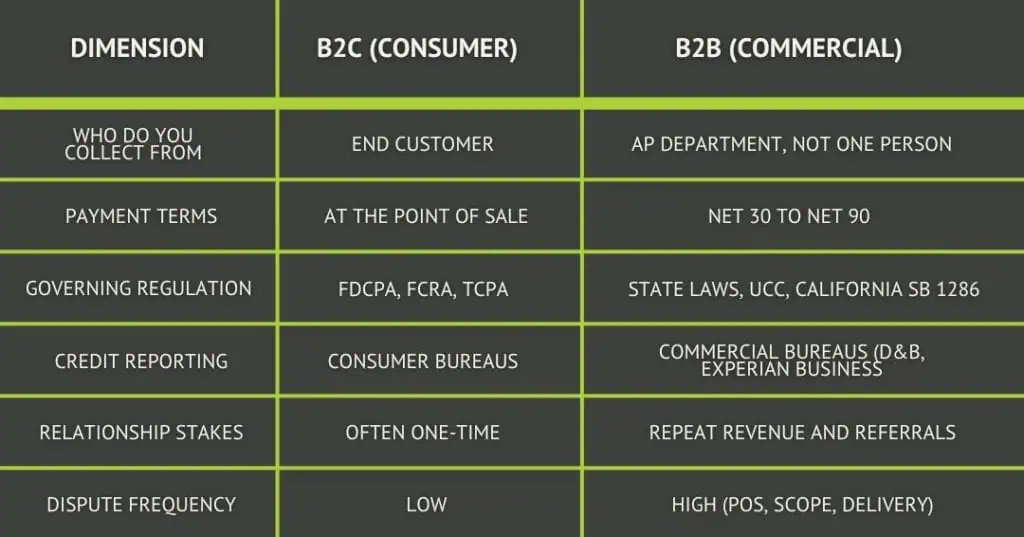
A consumer playbook (aggressive phone cadence, credit-bureau leverage) damages B2B relationships and usually misses the real problem: a disputed invoice stuck in an AP queue.
How to Build an Effective Commercial Collections Plan
1. Document a Written Credit Policy
Decide in advance who gets credit and on what terms. A written policy should cover credit application requirements (EIN, trade references, financials), credit limits by customer tier, standard payment terms, security requirements for higher-risk accounts (personal guarantees, UCC-1 filings, mechanic’s lien rights), and a review cadence. If this lives in one person’s head, it is not a policy. It is a liability.
2. Standardize Invoicing and Statement Cadence
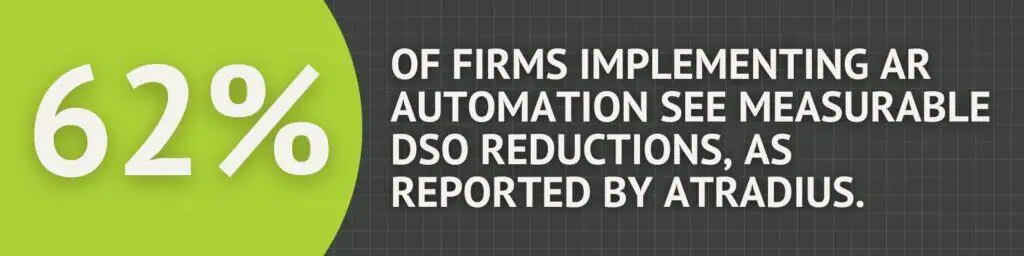
Clean invoices get paid faster. Send the invoice on delivery, not at the end of the month. Show the calendar due date (not just “Net 30”). Include PO number, line-item breakdown, and electronic payment options. Automate reminders at day 15 (courtesy), day 31 (first past-due), and day 46 (second past-due). Atradius reports 62% of firms implementing AR automation see measurable DSO reductions.
3. Tie Escalation Triggers to Aging Buckets
This is the component most plans lack. Every aging bucket should trigger a specific, documented action:
- Days 1 to 30: Automated reminder at day 15.
- Days 31 to 60: First past-due notice; phone call from AR by day 45.
- Days 61 to 90: Formal demand letter; credit hold; loop in the sales rep.
- Days 91 to 120: Final notice. Decision point to place with a collection agency.
- Day 120+: Place with a third-party agency. Internal recovery past this point is rare and expensive.
4. Build a Dispute and Partial-Payment Workflow
A significant share of “late” B2B invoices are disputed, stuck in an approval queue, or waiting for a credit memo. Log every dispute with a ticket, owner, and a 10-business-day resolution target. Accept partial payment against undisputed portions (do not hold an entire balance hostage over one line item). Route disputes to the sales or operations owner who can actually resolve them.
5. Predefine the Agency Handoff
Decide in advance at what age and balance an account gets placed. Most commercial collectors recommend placement between 90 and 120 days past due. Accounts placed past 180 days recover at roughly half the rate of accounts placed at 90. Your handoff protocol should specify the documents the agency needs, a single internal owner, and a weekly status cadence.
When to Escalate to a Commercial Collection Agency
Place an account with a commercial collection agency when it is 90 to 120 days past due with no promise to pay, when documented disputes are being ignored, when the customer has stopped responding, or when the balance justifies the contingency fee (typically 15% to 50%). A good agency recovers dollars you were going to write off, protects the relationship where possible, and flags accounts that warrant legal escalation.
Common Mistakes to Avoid
- No written policy. If your process lives in one person’s head, it walks out the door when they do.
- Waiting past 120 days to escalate. Recovery rates fall off a cliff after 180 days.
- Ignoring disputes. Disputes are a root cause of aged A/R, not a delay tactic.
- Using a consumer-focused agency. B2B recovery requires different tactics, bureaus, and legal tools.
- Writing off too quickly. Two- and three-year-old accounts can still be recovered by a specialist.
Frequently Asked Questions
What should a commercial collections plan include?
A commercial collections plan should include a written credit policy, a standardized invoicing and statement cadence, aging-based escalation triggers at 30, 60, 90, and 120 days past due, a dispute and partial-payment workflow, and a predefined handoff to a commercial collection agency. Track DSO, percent of A/R over 90 days, bad debt rate, and CEI monthly.
When should a business send an account to a commercial collection agency?
Most accounts should be placed between 90 and 120 days past due, after the internal team has completed a documented follow-up sequence. Placing earlier waste contingency fees. Placing later is worse: accounts placed past 180 days recover at roughly half the rate of accounts placed at 90 days.
Does the FDCPA apply to commercial debt?
No. The federal Fair Debt Collection Practices Act covers only debts incurred for personal, family, or household purposes. However, California’s SB 1286, effective July 2025, is the first state law to extend FDCPA-style protections to commercial debts under $500,000, and more states are expected to follow.
What is a good DSO for a B2B company in 2026?
The cross-industry median DSO is 56 days, but benchmarks vary widely by sector. A reasonable target is payment terms plus 10 to 15 days (a Net 30 company should target DSO under 45). Construction, engineering, and energy services run much longer, with sector medians above 80 days.
How much does a commercial collection agency cost?
Most commercial collection agencies charge on contingency, typically 15% to 50% of the amount recovered, with rates depending on account age and balance size. Some agencies offer a lower-cost early-intervention phase at a flat fee per account before escalating to contingency. You pay only for the money recovered.
Can you still collect on a B2B invoice that is over a year old?
Yes, though recovery rates drop sharply with age. Accounts one to two years old are routinely recovered by specialist commercial collectors, but the approach changes: more legal research (UCC filings, judgment leverage), state-specific statute-of-limitations analysis, and a focus on debtor solvency.
The Bottom Line
A commercial collections plan is not a document you write once and file. It is an operating system for your AR function: credit policy in, cash out, with documented decision points at every aging stage. The companies that outperform on DSO and bad-debt rate are the ones with the clearest plan, not the most aggressive collectors.
Kinum’s two-phase commercial collection system slots into the handoff step of exactly the kind of plan described above. Contact Kinum to pressure-test your current plan against your A/R.