


The warning signs a business client won’t pay typically include slow pay without a credible explanation, declining communication quality, NSF checks or declined payments, changing excuses on each follow-up call, and sudden shifts in their payment contacts. All of which tend to appear before the invoice is formally overdue.
There are warning signs that a B2B client is heading toward default. Most of them appear well before the invoice goes past due. Slow communication. Vague excuses. Payment patterns that quietly shift. The businesses that recover the most are those that spot these signals early and act before the debt becomes too old to collect effectively. This guide walks through the specific red flags to watch for, what they mean, and when it is time to bring in outside help.
Key Takeaways
- Slow pay is not automatically a red flag. Slow pay without a credible explanation is.
- Communication changes often signal financial distress before payment behavior does.
- Online reviews and public-facing signals can tell you a lot about a client’s operational health before invoices start slipping.
- Honesty is the real currency in a B2B credit relationship. Vague excuses are a worse sign than a difficult but truthful conversation.
- Consistent, professional multi-channel follow-up moves you up the priority list when a client is juggling multiple creditors.
- The older a B2B debt gets, the harder it becomes to recover. Early escalation to a commercial debt recovery partner preserves far more leverage than waiting.
The Difference Between Slow Pay and a Real Red Flag
Not every late payment is a warning sign. A government entity that consistently pays 60 days out is not the same risk as a small business that suddenly stops returning calls. The first one is a process issue. The second one is a problem.
The real red flag is slow pay without a credible explanation. A client who says, “We’re waiting on a funding cycle, and it usually lands by the 15th,” is giving you information. A client who says “we’re working on it” every time you follow up, without ever giving you a timeline, a reason, or a contact name, is not being honest with you. And in a B2B credit relationship, honesty is the real currency.
According to the U.S. Chamber of Commerce, 43% of U.S. B2B businesses report that their customers fail to pay invoices on time. The businesses that recover best are the ones that can tell the difference between a timing issue and an intent problem, and who act before it becomes the latter.
When you first notice a payment slipping, ask a direct question and pay close attention to the quality of the answer. The explanation matters more than the timeline.
Behavioral Warning Signs You Might Be Missing
Payment behavior is the most obvious signal. But the behavioral changes that predict a default often show up earlier. Here is what to watch for:
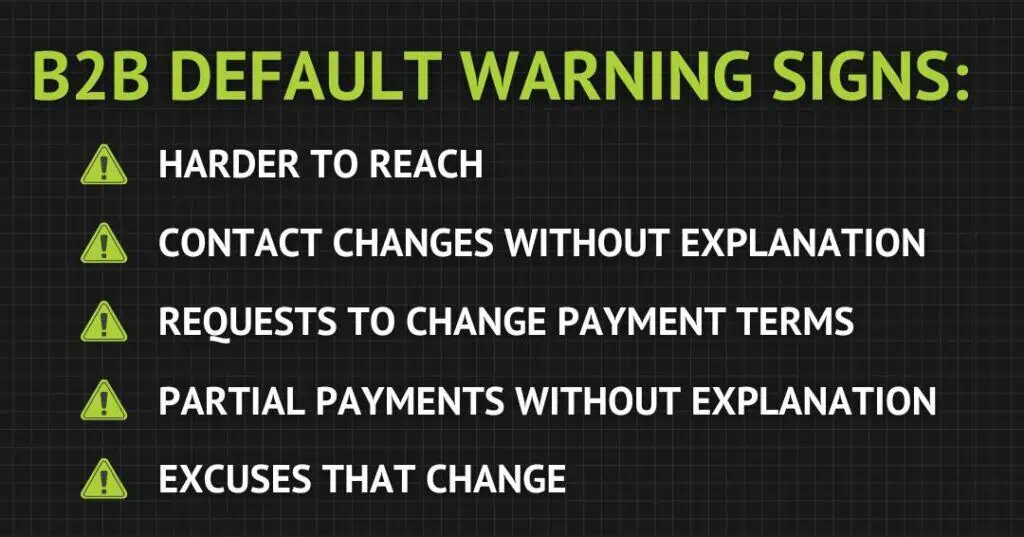
None of these signals on their own mean the debt will not be paid. Taken together, several of them mean you need to act now, not wait.
Financial and Operational Signals Worth Watching
Google reviews are a financial health indicator. Some of the most reliable early warning signs are ones most businesses never think to check. If customers or vendors are publicly complaining about billing problems, staff turnover, or operational chaos, that is a window into the health of the business before you ever see it in your B2B accounts receivable. A pattern of negative reviews about payment disputes or “impossible to get anyone on the phone” is worth taking seriously.
Other signals worth monitoring:
- NSF checks. A check that bounces once might be an error. A second one is a pattern.
- Declined credit card payments. If a client’s card starts declining on recurring charges, their cash position is tighter than their words suggest.
- Financing or banking changes. A client who suddenly switches banks or mentions they are “exploring new financing” may be doing so because their current bank will not extend them more credit.
- Abnormally large new contracts. A client who just landed an unusually large deal with an unfamiliar buyer introduces downstream risk: if that buyer does not pay them, they may not be able to pay you.
You do not need all of these signals to act. One or two, combined with behavioral changes, is enough reason to tighten your follow-up and stop extending additional credit.
When Excuses Replace Honesty, It’s Time to Act
There is an important distinction between a client who is struggling and a client who is stringing you along. The struggling client is honest. They tell you things are tight, here is why, and here is when they expect to make it right. That conversation is uncomfortable, but it is workable.
When a client cannot be honest about their situation, they need to become a priority. Not because you are being punitive, but because waiting is the one move guaranteed to make recovery harder. They are managing a list of creditors, and the ones who push hardest tend to get paid first.
At this point, document everything. Every call, every email, every commitment made and not kept. If this account eventually goes to a collections partner or into legal proceedings, that paper trail is the foundation of the case.
How to Get Yourself Higher on the Priority List
When you suspect a client is juggling creditors, the most effective move is simple: be consistent and persistent. Multi-channel contact (email, text, and phone) delivered professionally and on a regular schedule signals that you are not going away.
The squeaky wheel gets the grease. That is not just folk wisdom. In collections, it is a strategy. A creditor who follows up once a week across three channels is far more likely to get paid than a creditor who sends a single email and waits. You do not need to be loud. You need to be consistent.
If your internal team has been through this cycle with a client and the unpaid B2B invoices are still aging, it’s time to bring in outside support. A professional commercial debt recovery partner changes the dynamic. The client knows the relationship has entered a new phase, and the collections team knows how to apply the kind of persistent, professional pressure that internal AR teams typically cannot or should not apply on their own.
Kinum’s two-phase collection process moves from structured reminders to direct contact to professional collectors to legal follow-up when warranted, all on a contingency basis. No upfront cost, and you keep 100% of early-phase recoveries.
Frequently Asked Questions
What are the warning signs a B2B client won’t pay?
The clearest warning signs include slow pay without a credible explanation, communication that becomes harder to reach or less specific over time, changes in payment contacts without explanation, NSF checks or declined credit card payments, and excuses that change each time you follow up. Behavioral changes typically appear before payment delays, which means watching the relationship, not just the invoice age, gives you earlier warning.
How long should you wait before escalating unpaid B2B invoices?
Most businesses wait too long. Once an invoice reaches 45 to 60 days past due with no clear resolution in sight, escalation to a third-party commercial collections partner is worth considering. The older a B2B debt gets, the harder it is to collect, and the leverage you have decreases with every week that passes. Acting at 45 to 60 days preserves far more options than acting at 120.
What should you do when a business client stops communicating?
Document every attempt and escalate your contact frequency across multiple channels: email, phone, and text. If you have a contract, review your terms for default and late fee provisions. Send a formal written demand letter via certified mail noting the outstanding balance and a deadline for response. If no response is received within a reasonable window, engage a commercial collections partner. Silence is not a neutral signal. It is a warning.
When should you use a commercial debt collection agency?
When internal follow-up has not produced results after 45 to 60 days, or when the client’s communication has effectively stopped. A collections agency changes the dynamic of the relationship and applies consistent pressure through trained professionals who know how to navigate B2B defaults. Kinum works on a contingency basis, meaning there is no upfront cost, and you only pay when money is recovered. Learn more about the process at kinum.com/collecting-accounts-receivables.
Don’t Wait for a Default to Act Like One Is Coming
The businesses that recover the most on B2B debt are the ones that take early signals seriously. A single late payment with a vague excuse is a data point. Two or three of these patterns together (declining communication, changing excuses, NSF checks, a spike in negative reviews) is a picture worth acting on now.
If a business client is showing these signs, Kinum’s commercial collections team can help you move faster and recover more. Get in touch to learn how the two-phase process works at no upfront cost.