


Waiting on payments from customers is one of the most common frustrations business owners deal with. It strains cash flow, eats up staff time, and can force you to cover your own bills out of pocket while you wait. At Kinum, Inc., we work with businesses nationwide to recover past-due accounts, and we have seen firsthand what separates businesses that get paid on time from those that chase invoices for months.
According to a study by Wave Apps, 25 percent of businesses wait more than a year to be paid, and 70 percent wait between one and six months. That gap can leave owners borrowing from personal accounts or delaying their own paychecks just to make payroll. Below are the strategies that actually move the needle, along with the reasons customers fall behind in the first place so you can address the root cause, not just the symptom.
Set Clear Payment Terms From the Start
Communicate your payment terms before the work begins, not after the invoice is late. Customers should know exactly when payment is due and what happens if it is not, in writing in the contract and verbally, if possible. Ambiguity is one of the most common reasons invoices go unpaid. A customer who was never clearly told the terms has a built-in excuse for paying late, and that excuse is usually a fair one if your own paperwork was not clear to begin with.
Ask for Payment Upfront or in Stages
Depending on the size of the job, consider requiring full payment upfront, or splitting it into stages, for example half at the start and half on completion. This protects your business on larger projects and removes the uncertainty of waiting for a single lump payment at the end. Staggered payment structures, such as a percentage upfront, a percentage at a milestone, and the remainder at completion, work well for longer engagements. For recurring or subscription-style services, consider billing at the start of each cycle rather than the end, so payment always precedes delivery of the next cycle’s work.
Follow a Consistent Invoicing Schedule
Send invoices on the same schedule every time. Customers learn to expect an invoice on a certain day of the month, which makes it part of their routine rather than a surprise. Follow up proactively before the due date arrives rather than waiting until an account is already overdue. Tools like Wave or QuickBooks can automate these reminders so the follow-up happens consistently without extra staff time.
Make Paying Easy
Customers pay faster when it is simple to do so. Accept online payments and offer multiple payment methods. Every extra step between a customer deciding to pay and actually completing payment is a chance for the payment to stall. If a customer has to print a form, write a check, and mail it, you have built three separate opportunities for the payment to be delayed or forgotten entirely.
Use Incentives and Penalties Together
A small discount, for example 1 to 2 percent off for payment within ten days, rewards the customers who are already paying reliably and gives slower payers a reason to move faster. On the other side, a clearly stated late fee, often 1.5 to 2 percent, signals that on-time payment is taken seriously. A common structure looks like this:
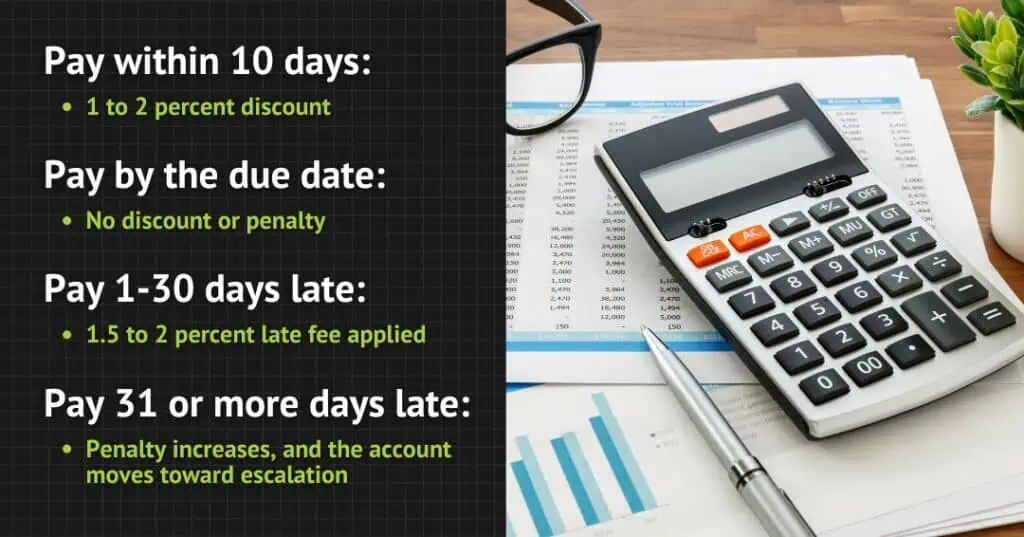
Whichever combination you choose, put both in writing before a customer signs on, and check your state’s usury laws before setting a late fee percentage, since maximum allowable rates vary by state.
Reward Customers Who Consistently Pay On Time
Incentives do not have to be limited to a single invoice. Customers with a strong history of on-time payment are often your best customers overall, and it is worth acknowledging that. Priority scheduling, small loyalty discounts, or simply being first in line for a new service or product can reinforce the behavior you want to see more of, without cutting into your margin the way a blanket discount would.
Build Personal Relationships With Your Customers
Customers are more likely to prioritize an invoice from someone they have an actual relationship with over a generic reminder from an accounting inbox. Where it makes sense, have the salesperson or account manager who worked with the client be part of the payment conversation, not just an anonymous billing department. A brief, friendly check-in call from someone the customer already knows often resolves a stalled payment faster than a second or third automated reminder ever will.
Have a Clear Escalation Policy
Decide in advance what happens when reminders and calls do not result in payment. A defined collection policy, including when an account is sent to a collection agency, keeps the process consistent and takes the guesswork out of an uncomfortable conversation. Write this policy down and apply it consistently to every customer, since inconsistent enforcement is one of the fastest ways to teach your most difficult customers that the rules do not really apply to them.
Understand Why Customers Do Not Pay
Most customers do not enter into an agreement planning to pay late. Understanding the common reasons for non-payment helps you fix the cause rather than just chase the symptom.
- The Invoice Never Arrived. Sometimes the invoice was lost in the mail, buried in a spam folder, or the point of contact at the customer’s business changed and no one saw it. A quick follow-up call to confirm receipt solves this immediately and also builds rapport.
- The Customer Cannot Pay Right Now. Financial hardship happens, and it is not always predictable. A direct conversation about what is going on, paired with a manageable payment plan, often resolves this faster than repeated reminders that go nowhere.
- The Bill Was a Surprise. When a customer receives a bill that is bigger than expected or one they did not anticipate at all, some will shut down rather than call to ask about it. Setting clear expectations about pricing and payment schedules from the start prevents this reaction before it happens.
- The Customer Has Learned They Can Get Away With It. If your business has historically been lenient about late payments, some customers will take advantage of that pattern. Standardizing your credit policy across all customers, without exceptions that get talked about, closes this loophole.
Put It All Together
No single tactic on this list solves late payments on its own. Clear terms prevent confusion, consistent invoicing builds routine, incentives and penalties create urgency, and understanding why a specific customer fell behind tells you which lever to pull. Businesses that combine several of these strategies consistently see fewer accounts drift into serious delinquency in the first place, which means less time spent chasing payments and more time spent running the business.
Frequently Asked Questions
What is the most effective way to get customers to pay on time?
Setting clear payment terms in writing before work begins, combined with proactive reminders before the due date, prevents most late payments before they happen.
Why do customers not pay their invoices?
Common reasons include a lost or unseen invoice, an unexpected bill amount, temporary financial hardship, or a history of lenient follow-up that signals late payment is acceptable.
Should I offer a discount for early payment or a penalty for late payment?
Both, used together. A small early-payment discount rewards reliable customers, while a clearly stated late fee gives slower payers a reason to prioritize your invoice.
Is there a limit to how much I can charge as a late fee?
Yes. Maximum allowable late fee and interest rates vary by state under usury laws, so confirm your state’s limits before setting a penalty percentage.
When Reminders Are Not Enough
If a customer continues to miss payments after reminder emails and phone calls, it may be time to bring in a collection agency. Kinum, Inc. works with businesses across the country to recover past-due accounts while protecting the customer relationships you have built. Contact us today at 888-471-0280 for help collecting on outstanding balances.