



Dental claim denials that shift to patient responsibility are one of the most common and often the least well-managed revenue problems in dental practices. When an insurer refuses to cover a procedure, that balance does not disappear; it lands on the patient, usually without any advance explanation of why.
Most practices know when a denial comes back. Fewer have a clear, consistent process for what happens next. The appeal, the patient statement, the internal follow-up, the eventual handoff to collections: each step matters, and the gaps between them are where revenue quietly disappears.
This guide covers the full arc from the moment a dental insurance claim is denied through the point where a professional collections agency is the right call.
Key Takeaways
- A dental insurance denial creates patient debt when the insurer refuses to pay and the outstanding balance shifts to the patient, often with no explanation attached to the statement they receive.
- Appeal the denial before billing the patient, because depending on network status and denial reason, billing too early may violate your provider agreement and damage the patient relationship.
- Patient statements after a denial must explain why the balance exists, since patients who receive a bill with no context are far less likely to pay it promptly.
- A structured internal follow-up process, documented at every step, gives the practice its best chance of recovery before escalating to a collections partner.
- Most dental practices refer accounts to collections after 90 to 180 days of unsuccessful internal follow-up, though earlier referral generally produces better recovery rates.
- A HIPAA-compliant, dental-experienced collections partner recovers more while protecting the patient relationships your practice has worked to build.
Why Do Dental Insurance Denials Become Unpaid Balances?
Not every denied claim ends up in collections, but the ones that do almost always follow the same path: a gap in the process between the denial and the patient’s statement that nobody closed.
The sequence is familiar to anyone who has worked in dental billing. The patient receives treatment, the claim goes to the insurer, and weeks pass with no communication in either direction. Then the practice, moving quickly to keep cash flowing, sends a statement with a balance due and no explanation attached. The patient, who assumed coverage was handling things, has no idea why they are receiving a bill or what they are supposed to do about it.
That confusion is the problem. People do not pay bills they do not understand, and most patients will set an unexplained statement aside rather than call the office to sort it out. The balance ages, the practice follows up, and what started as an insurance issue becomes a collections situation that was almost entirely preventable.
The scale of this plays out across the industry. According to the ADA Health Policy Institute, more than half of dentists cite denied or delayed insurance reimbursement as one of their top practice challenges, and most practices see initial denial rates of 5-15 percent of submitted claims, depending on payer mix and documentation quality. Across a busy practice, those percentages represent real money sitting in limbo.
Most of those balances are recoverable. The difference is almost always process.
Step One: Appeal the Denial Before Sending the Patient a Balance
Appeal the denial before sending the patient a statement. Billing the patient before the insurance process is fully exhausted, before the final EOB confirms patient responsibility, is one of the most common and damaging mistakes in dental billing. It can cause bill shock, erode trust, and may violate your provider agreement, depending on the denial reason and your network status.
The rules vary. In-network providers are often restricted from passing certain denied balances to patients, particularly when the denial stems from a practice-side error, such as a missed timely filing deadline. Out-of-network providers have more flexibility. Denials tied to exhausted benefits or loss of coverage typically allow patient billing; denials for bundling issues or timely filing often do not.
The ADA’s guidance on overdue accounts recommends collecting the patient-responsible portion promptly once confirmed. Work the appeal first. Most carriers allow 30 to 180 days from the denial date. Once the final EOB establishes patient responsibility, the statement goes out with a clear explanation attached.
Step Two: Communicate the Denial Clearly to Prevent Unpaid Patient Debt
When it’s time to bill the patient, the statement must explain why the balance exists. A single line, “Your insurance claim was denied. That is why you are receiving this bill”, makes an enormous difference in whether the patient engages with it, and the absence of that line is one of the most common reasons denied-claim balances go unpaid.
A pre-printed notice attached to the statement works just as well as an explanation in the statement itself. The format matters less than the fact that the explanation is there. When a patient understands why they owe money, they are more likely to pay, more likely to respond to follow-up, and, when frustrated, more likely to redirect that frustration toward the insurer rather than the practice.
Step Three: Work the Balance With a Structured Internal Follow-Up Process
Before referring a denied-claim balance to collections, the practice should exhaust a structured internal follow-up process, typically at least 90 days of documented attempts at contact.
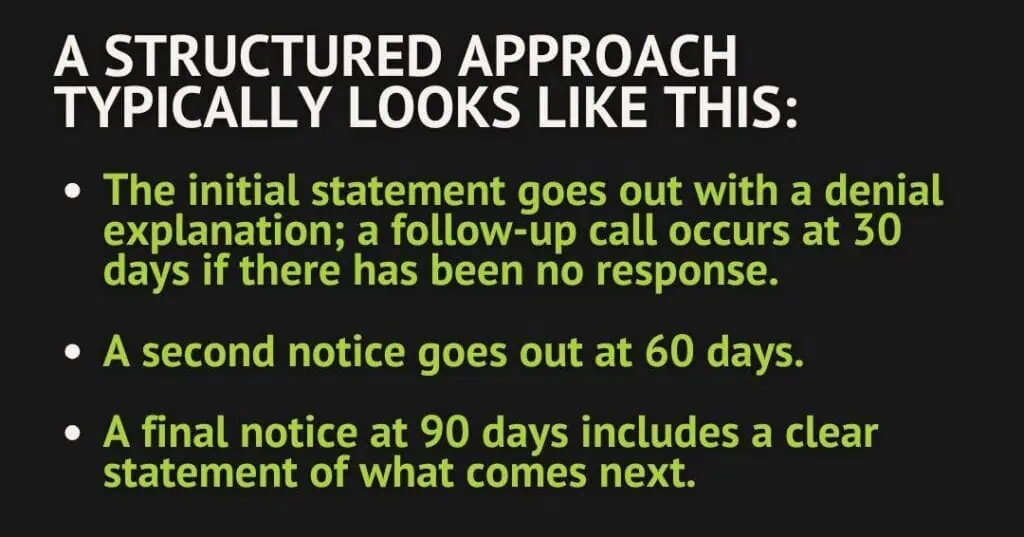
At any point in that sequence, offering a payment plan can recover an account that would otherwise go cold, since patients who understand the balance but are facing financial hardship will often commit to a schedule they can actually manage.
Every contact attempt should be documented, including the date, the method, and the outcome. That documentation serves two purposes: it keeps the billing team aligned on where each account stands, and it demonstrates that reasonable internal efforts were made if the account eventually moves to a collection agency, which is both a practical and a legal protection for the practice. What does not work, at any stage of this process, is letting time pass without action.
When to Hand the Account to a Dental Collection Agency
At some point, internal follow-up has done what it can. Multiple notices have gone out, calls have been made, and the balance is still not moving, which is the point where professional dental billing collections become the right call rather than a last resort.
Most dental practices refer accounts to collections after 90 to 180 days of unsuccessful internal follow-up, though the specific timeline should be set in the practice’s financial policy rather than decided account by account.
The timing of that referral matters more than most practices realize. Research shows that collectability drops to roughly 74 percent once an account reaches 90 days past due and falls below 50 percent after nine months, which means that waiting longer does not protect the patient relationship; it simply reduces the likelihood of ever recovering the balance.
The signs that an account is ready for escalation are usually clear: no response to multiple contacts over a documented period, an unresolved dispute the practice cannot settle internally, or a patient who cannot be located at all. Any one of those signals, following a genuine internal effort, is a reasonable trigger for referral.
Choosing the right partner matters as much as the timing. HIPAA compliance is non-negotiable. Dental-specific experience means collectors understand that most of these balances involve insurance confusion or financial hardship rather than deliberate avoidance. And a contingency-only model means no upfront cost; the practice pays only when money is recovered.
Kinum’s dental collections services are built specifically for this transition. When a practice has worked an account thoroughly and needs a partner to carry it forward, Kinum steps in with a structured, HIPAA-compliant process: Phase 1 contacts go out in the practice’s name, preserving the relationship while expanding the reach, and if Phase 1 does not resolve the account, Phase 2 brings in professional collectors with skip trace capability and, when warranted, a nationwide network of attorneys.
For more on what the process looks like from the inside, the post on reasons to work with a collections agency covers the case in plain terms.
FAQ
Who is responsible for a dental bill when insurance denies the claim?
When a dental insurance claim is denied and all appeals are exhausted, the patient or responsible party is typically responsible for the outstanding balance, but whether the practice can bill the patient depends on the denial reason and the provider’s network agreement. In-network providers may not be permitted to bill patients for certain denial types, so the final Explanation of Benefits should always confirm patient responsibility before a statement gets sent.
How long does a dental office wait before sending a bill to collections?
Most dental practices refer accounts to collections after 90 to 180 days of unsuccessful internal follow-up, and earlier referral is generally better because collectability drops significantly once an account passes the 90-day mark. The specific trigger should be documented in the practice’s financial policy rather than decided ad hoc, and accounts with no response to multiple contacts, unresolved disputes, or patients who cannot be located are strong candidates for earlier escalation within that window.
Can a dental office send a denied insurance balance to collections?
Yes. Once a denied claim’s balance has been confirmed as the patient’s responsibility through the final EOB and reasonable internal collection efforts have failed, the practice has the legal right to refer that balance to a professional collection agency. The agency must comply with the Fair Debt Collection Practices Act, and for dental practices, a HIPAA-compliant agency is also essential given the sensitivity of health-related billing information.
What should a patient statement say after a dental insurance denial?
Every statement following a confirmed dental insurance denial should include a brief explanation of why the balance exists, because patients who receive a bill with no context are far more likely to ignore it than to pay it. One sentence is sufficient: “Your insurance claim was denied. That is why you are receiving this bill.” Without that explanation, patients are more likely to be confused, delay payment, or call the office with questions that the statement should have answered upfront.
How do I choose a collection agency for my dental practice?
Look for an agency that is HIPAA-compliant and has demonstrated experience with dental or healthcare accounts. Dental-specific experience matters because collectors who understand insurance confusion and patient financial hardship handle these conversations differently from standard commercial debt, and asking about their patient communication approach before signing anything is a reasonable due diligence step.
The Denial Is the Beginning, Not the End
A dental insurance denial is not the end of the revenue cycle. It is the start of a different process, one that requires clear communication, structured follow-up, and a deliberate decision about when professional help makes more sense than continued internal effort.
Practices that manage denied-claim patient debt well recover more, write off less, and preserve more of the patient relationships that keep the practice financially healthy. What separates practices that recover these balances from those that write them off is simply the consistency with which the process gets applied.
When your internal process has run its course and balances are still aging, Kinum’s dental collections services are designed for exactly that situation. Contact our team to learn how we help dental practices improve their dental collections process without damaging the patient relationships they have worked to build.