


Credit reporting in collections is the process by which collection agencies report unpaid debts to credit bureaus on behalf of their clients. Done properly, it preserves your leverage for recovery and protects you under the FCRA. Done poorly, often by agencies that auto-delete disputed debts, it quietly destroys your recovery rate and exposes you to legal liability.
When a consumer disputes a debt, most collection agencies take the easy way out. They remove it. The debt disappears, the dispute closes, and the agency moves on.
But here’s what just happened: your legitimate debt vanished from the credit bureau because someone sent a template dispute letter they found online. The consumer learned that simply sending a template dispute letter works, and you lost powerful leverage in recovering the debt.
This happens thousands of times a day. According to CFPB’s 2024 Consumer Response Annual Report, credit reporting complaints hit an all-time high of 2.7 million in 2024—up 180% over two years.
The question is: does your collection agency handle disputes properly, or are they undermining your recovery?
What Actually Happens When You Report to Credit Bureaus
When your agency reports a debt, it appears under their name, not yours. The consumer sees the agency name on their credit report, disputes it with the credit bureau, the bureau forwards that dispute to the agency, and the agency has 30 days to respond.
What happens next could determine whether you recover that debt or lose it permanently.
The FCRA Verification Process Most Agencies Skip
Under the Fair Credit Reporting Act, agencies must conduct a reasonable investigation when a consumer disputes a debt:
- Read the dispute carefully. What is the consumer challenging: the amount, ownership, or dates?
- Request documentation from you. Signed agreements, account statements, payment history, whatever validates the specific claim.
- Verify the details. Match the documentation against the dispute.
- Respond to the consumer. Send the verification with supporting documentation.
- Continue reporting. Mark the account as disputed, but keep it on the credit report.
This process takes time and coordination. So many agencies skip it. They remove the debt the moment a dispute arises because it’s faster and easier—and it creates a massive problem for creditors.
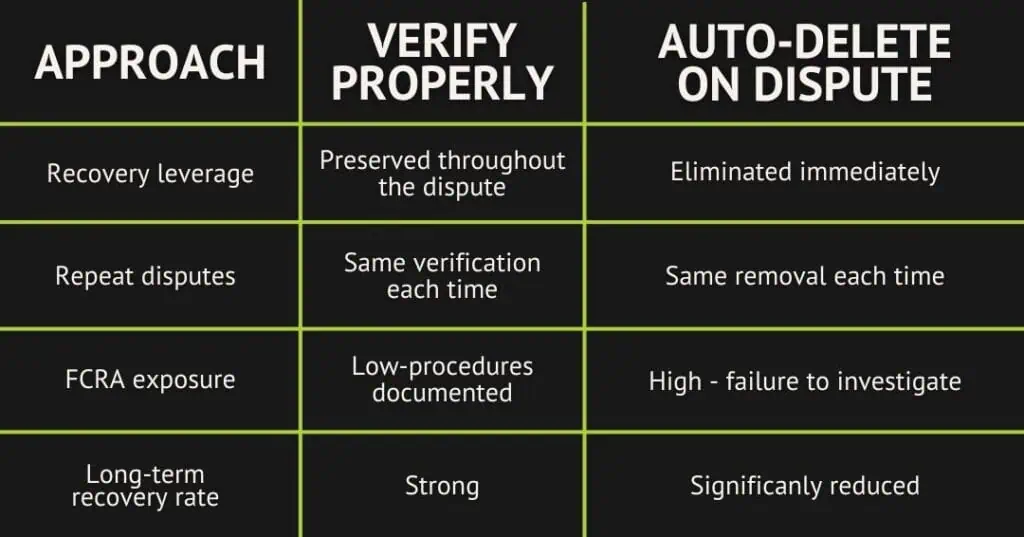
Verify vs. Delete: The Difference in Outcomes
Why Removing Disputed Debts Hurts Your Recovery
When an agency deletes a disputed debt without verification, three things happen:
You lose leverage. Credit reporting is often the only reason a debtor pays. Consumers who dispute care about their credit; that motivation disappears when the agency removes it for them.
The consumer learns the system. They will send the same dispute letter again next month. Meanwhile, the 2026 FCRA updates are tightening verification standards, making generic disputes more likely to be rejected as frivolous.
Your legitimate debt becomes uncollectible. Once removed, the debtor has no incentive to pay; the account ages, and the odds of recovery drop.
The Compliance Cost of Cutting Corners
Beyond the loss of recovery, improper credit reporting creates legal exposure. Consumers who prevail in FCRA cases can recover actual damages, statutory damages of $100 to $1,000 per violation, and attorney fees.
But here’s what matters more: under UDAAP enforcement (the federal rule against Unfair, Deceptive, or Abusive Acts or Practices), creditors can be held partly responsible for the unlawful actions of their collection agencies. Their compliance failures become your liability.
How Kinum Handles Credit Reporting in Collections
At Kinum, we treat every dispute as an opportunity to validate legitimate debts, not a reason to remove them. We read each dispute, reach out to you for the specific documentation needed, and validate the claim with actual proof. Once verified, we send the documentation to the consumer and continue reporting the account as disputed.
Even when consumers send the same dispute letter repeatedly, a common credit repair tactic, we follow the full verification process every time. Our client portal gives you real-time visibility into every dispute and allows you to upload the verification of debt so Kinum can respond appropriately to the consumer.
Questions to Ask Before You Sign with a Collection Agency
Most businesses evaluate agencies on recovery rates and fees. Credit reporting practices matter just as much:
- “Do you report to the credit bureaus, and if so, to which ones?”
- “Walk me through your dispute process.” Listen for verification, documentation, and continued reporting, not “we close them quickly.”
- “How often do you request validation documentation from clients?” Rarely asking is a red flag.
- “What percentage of your reported accounts get disputed?” The industry average is around 1.1%. A much lower number may mean they’re removing disputes early.
- “How do you handle repeat disputes on the same account?” The answer should be the same verification process every time.
What This Means for Your Business
The 2026 FCRA updates will require stricter timelines and enhanced verification. Agencies with proper processes will adapt easily. The ones cutting corners will struggle, and so will their clients.
Partner with agencies that treat credit reporting as a strategic advantage, not a compliance burden. Kinum’s 4-step process of pre-collections, credit reporting, collections, and legal intervention integrates compliance at every stage. With 100+ years of collective experience and partnerships with bureaus like Experian, we’ve built systems designed to handle disputes correctly while maximizing recovery.
Because when a consumer disputes a debt, what happens next determines whether you recover that money or lose it forever.
Frequently Asked Questions
What is credit reporting in collections?
It’s the process where a collection agency reports an unpaid debt to credit bureaus on behalf of the creditor. The debt appears under the agency’s name and stays on the consumer’s report—typically up to seven years—unless resolved or removed.
Can a collection agency remove a debt from my credit report?
Yes, and many do so the moment a dispute arises. Under the FCRA, however, the correct response is a reasonable investigation, not automatic deletion.
How long does a collection account stay on a credit report?
Up to seven years from the original delinquency date, provided it’s accurately reported and properly verified when disputed.
What is the average dispute rate for collection accounts?
About 1.1%. Significantly lower numbers can indicate an agency is removing disputed debts before they become formal disputes.
Ready to Partner with an Agency That Does Credit Reporting Right?
If your current agency is removing disputed debts without verification, you’re losing money. Kinum handles credit reporting in collections the right way: full documentation, proper verification, and continued reporting that maintains your leverage.
Schedule your free consultation and see how proper dispute handling can improve your recovery rate.