


A collection letter is a written notice that asks a customer to pay an overdue balance, and a good collection letter template makes it easy to send the right message every time. Most businesses get the best results from a short series of letters that grow firmer over time: a friendly reminder, a second notice, and a final notice before the account goes to collections. Each letter should be clear, polite, and specific about what is owed and how to pay.
This guide is for business owners, office managers, and billing staff who send their own past-due notices. It covers what every collection letter should include, when to send each stage, a collection letter template for all three stages, short email and text versions, and what to do when the letters stop working.
Key Takeaways
- A good collection letter states the amount owed, the original due date, how to pay, and who to contact with questions.
- Most businesses use three stages: a friendly reminder, a second notice, and a final notice before collections.
- Tone should get firmer with each letter but stay respectful, since many clients and late payers still want to keep the relationship.
- Email alone is not enough, because a large share of business email never gets opened.
- Letters and calls from the business itself work best in the first 60 to 90 days after the due date.
- Once a final notice goes unanswered, a professional collection process usually works better than another letter.
What a Collection Letter Should Include
Every collection letter, no matter how firm, needs the same core facts. Missing details give the customer a reason to delay, so it pays to get them right the first time.
- Customer name and account number so there is no confusion about who owes the balance.
- Invoice number, service date, and original due date to show exactly what the charge is for.
- Amount due, including any late fee that the customer agreed to in writing.
- Payment options, such as an online payment link, mailing address, or phone number.
- A clear deadline for payment or a response.
- A contact name and phone number for questions or payment plan requests.
Late fees deserve special care. A business should only add fees that appear in its written terms, which is why it helps to have a clear late fee policy in place before the first letter goes out. Clear terms up front also make it easier to keep customers paying on time in the first place.
The Three-Stage Letter Sequence and When to Send Each One
A set schedule takes the guesswork out of follow-up. It also keeps the process fair, since every late customer gets the same treatment. The table below shows a common timeline that many small businesses and practices use.
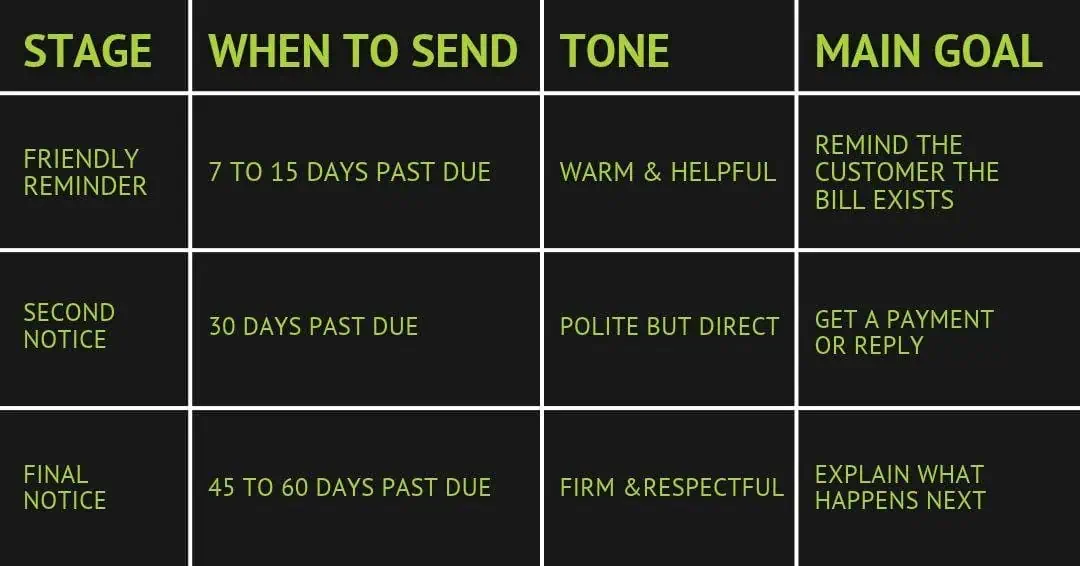
The exact days can shift based on the business. A dental practice that bills at the time of service may start sooner, while a business that bills on net 30 terms may wait until the invoice is a few weeks late. What matters most is that the schedule stays the same for every account.
Collection Letter Template 1: The Friendly Reminder
The first letter should assume the customer simply forgot. Most people who are a few days late do intend to pay, so a warm tone keeps the relationship strong. The goal is to make paying as easy as possible.
Sample friendly reminder
Dear [Customer Name],
This is a friendly reminder that invoice #[Number] for $[Amount] was due on [Date]. If payment has already been sent, thank you, and please disregard this note.
Payment can be made online at [Link], by phone at [Phone], or by mail to [Address]. If there is a question about this bill, please contact [Name] at [Phone or Email].
Thank you.
[Business Name]
Collection Letter Template 2: The Second Notice
The second notice goes out when the first reminder gets no response. The tone is still polite, but the message is more direct. This letter should ask the customer to either pay or get in touch by a set date.
Sample second notice
Dear [Customer Name],
Records show that invoice #[Number] for $[Amount] is now [Number] days past due. A reminder was sent on [Date], and the balance remains open.
Please submit payment by [Deadline] using [Payment Options]. If a payment plan would help, contact [Name] at [Phone] before that date to discuss options.
[Business Name]
This is also a good time to call. A calm opener such as “we’re just following up” works well when phoning a customer about a late bill. A friendly call often gets a reply when a letter does not.
Collection Letter Template 3: The Final Notice Before Collections
The final notice is the last letter a business sends before placing the account with a collection agency. Some people call it a final demand letter. It should stay calm and factual while clearly explaining what will happen if the balance stays unpaid.
Sample final notice
Dear [Customer Name],
Invoice #[Number] for $[Amount] is now [Number] days past due. Reminders were sent on [Date] and [Date], and no payment or response has been received.
If payment or a payment plan is not arranged by [Deadline], this account will be referred to a collection partner for further action.
To resolve this now, please pay at [Link] or call [Name] at [Phone].
[Business Name]
A final notice should only mention steps the business is ready to take. Collection rules also vary by state, so check local requirements before sending any final notice. Third-party collectors follow federal rules such as Regulation F under the Fair Debt Collection Practices Act, which is one reason a business’s letters look different from an agency’s.
Email and Text Versions
Many customers respond faster to a short email or text than to a mailed letter. These versions work well alongside the letters, not in place of them.
Email subject line: Reminder: Invoice #[Number] is past due
Email body: Hi [Name], this is a quick reminder that invoice #[Number] for $[Amount] was due on [Date]. Pay online at [Link] or reply to this email with any questions. Thank you!
Text message: [Business Name]: Invoice #[Number] for $[Amount] is past due. Please pay at [Link] or call [Phone] with questions, and reply STOP to opt out.
Email has one big weakness. More than 30% of all email does not get opened, so a customer can honestly say they never saw it. Pairing email with mailed letters and a phone call gives the business a stronger record that the customer was told.
Why Letters Alone Stop Working After 90 Days
Letters and calls from the business itself work best early. Internal follow-up is most useful in the first 60 to 90 days after the due date. After that point, letters and phone calls from the business tend to stop working.
The reason is simple: a customer who has ignored three letters has already decided the bill is not a priority, which is often one of the warning signs a business’s client won’t pay. Sending a fourth letter from the same business rarely changes that decision. Staff time also costs money, so chasing older balances can turn into spending good money to chase bad money.
This is where Kinum’s process fits. In Phase 1, Kinum sends three letters in the client’s own name, along with two friendly reminder calls. If that does not work, Kinum steps in with official collection contacts using emails, texts, and professional collectors. Customers who pay or respond during Phase 1 are returned to the business, which helps protect the relationship.
FAQ
How long after an invoice is due should a reminder go out?
Most businesses send the first reminder 7 to 15 days after the due date. This gives the customer a short grace period while the bill is still fresh. Waiting much longer makes the balance harder to collect, since older invoices get pushed down the customer’s list. A set schedule helps make sure every late account gets the same timely reminder.
What should a final notice say?
A final notice should list the invoice number, amount, and due date, along with the dates of earlier reminders. It should set a clear deadline and explain the next step, such as referral to a collection agency. The tone should stay calm and factual. It should only mention actions the business is truly ready to take.
Is a final notice the same as a demand letter?
A final notice and a demand letter are very similar. Both are formal requests for payment that explain what will happen if the balance stays unpaid. “Demand letter” is often used when legal action is being considered, while “final notice” is common for businesses preparing to refer an account to collections. Either way, the letter should be clear and respectful.
Can collection letters be sent by email?
Collection letters can be sent by email, and email is a fast, low-cost option. However, many business emails never get opened, so email should not be the only method. Pairing email with mailed letters, text reminders, and phone calls gives a better response rate. It also creates a stronger record that the customer was notified about the balance.
Letting a Partner Send the Collection Letters
A clear series of collection letters helps businesses get paid without damaging good customer relationships. A friendly reminder, a second notice, and a final notice cover most late accounts, as long as they go out on a steady schedule.
Businesses that would rather not manage the letters themselves can hand that work to Kinum. Kinum’s accounts receivable collection services send reminders in the client’s own name first and move to professional collections only if needed. Businesses can contact Kinum to learn how the process works.