


Key Takeaways
The No Surprises Act protects patients from unexpected medical bills, but it also changes how you handle billing and collections. Here’s what you need to know:
- The law prevents more than 1 million surprise bills per month from reaching patients
- You must provide Good Faith Estimates to uninsured and self-pay patients within specific timeframes
- Dental practices have limited NSA requirements, but still need to follow good faith estimate rules
- The law shifts more financial responsibility to providers upfront, which affects your collections timeline
- Compliance with NSA requirements protects your practice from penalties and maintains patient trust
At Kinum, we help healthcare and dental practices recover revenue while remaining compliant with regulations such as the No Surprises Act. Our people-first approach protects your relationships while addressing the financial realities your practice faces.
What Does The No Surprises Act Actually Do?
The No Surprises Act took effect on January 1, 2022. It protects patients with private insurance from surprise medical bills in three situations: emergency care, non-emergency services from out-of-network providers at in-network facilities, and air ambulance services.
Before this law, one in five emergency room visits resulted in a surprise bill. Up to 16% of in-network hospitalizations also led to unexpected charges from out-of-network providers.
The law covers more than 200 million Americans with private health insurance. During the first nine months of 2023 alone, it prevented over 10 million surprise medical bills.
For your practice, this means you can no longer balance bill patients in covered situations. The financial dispute moves between you and the insurance company through a federal independent dispute resolution process.
How Does NSA Affect Your Billing Process?
The No Surprises Act changes your billing workflow in specific ways.
Good Faith Estimates Are Now Required
You must provide good-faith estimates to uninsured and self-pay patients before services are provided. This includes patients who have insurance but choose not to use it.
The estimate must include expected charges for the service and any related items. You have three business days to provide this estimate after a patient requests it. For scheduled services, you should provide them at least seven business days before treatment.
If your actual bill exceeds the good-faith estimate by $400 or more, you can dispute it through a patient-provider dispute resolution process.
What This Means for Collections
The good faith estimate requirement affects your collections timeline. Patients now have clear documentation of expected costs upfront. When actual charges differ significantly, you face potential disputes before you can move forward with collections.
This creates a new compliance checkpoint in your revenue cycle. Your billing team needs accurate cost estimation processes. Your collections partner needs to understand these requirements.
Special Considerations for Dental Practices
Dental practices face different NSA requirements than medical providers.
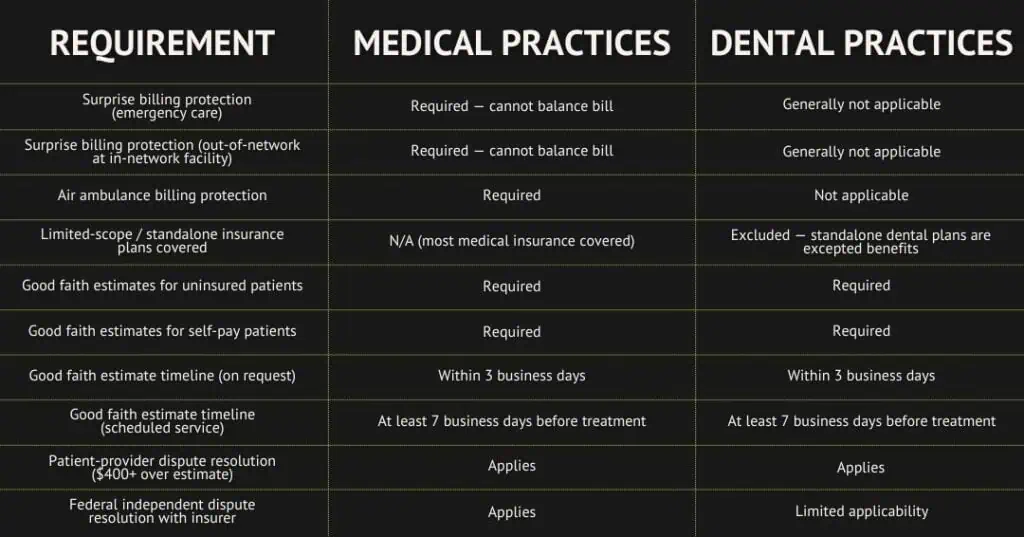
For dental practices, this means your front desk staff needs clear protocols. They need to identify which patients require good faith estimates and provide them within the required timeframes.
What Is the Connection Between NSA and Collections?
The No Surprises Act directly impacts your collections process.
Reduced Surprise Bills Mean Different Collection Scenarios
Before the NSA, surprise medical bills often cost thousands of dollars. Patients who refused to pay these bills faced collections and credit damage.
Now, those surprise bills do not reach patients in covered situations. The balances you send to collections are different. They are expected charges, charges from good faith estimates, or balances from non-covered situations.
This changes the conversation during collections. Patients have less basis to claim they did not know about charges. Your collections partner needs to reference the good-faith estimate and the documented communication.
Compliance Requirements Extend to Collections
Your collections process must align with NSA requirements. If you provided a good faith estimate, your collections communications should reference it. If a patient disputes a charge under the NSA provisions, your collections activity must pause while the dispute is resolved.
Failure to comply creates legal risk. It also damages patient relationships. A study showed the NSA reduced out-of-pocket spending by 15.6% on average. Patients expect this protection. When your collections process ignores it, you face complaints and reputation damage.
What Healthcare Providers Should Do Now
You need a clear plan to handle NSA requirements in your billing and collections process.
Update Your Billing Procedures
Train your staff to identify which patients need good faith estimates. Create templates that include all required information. Set up systems to track when estimates were provided and what they included.
Document everything. When a patient receives an estimate, note it in their file. When actual charges differ from the estimate, document why.
Review Your Collections Partnership
Your collections partner needs to understand NSA requirements. They should know when to reference good faith estimates. They need protocols for handling NSA-related disputes.
Ask your collections partner how they handle NSA compliance. If they cannot answer clearly, you have a problem.
Monitor Your Compliance
Track how often you provide good faith estimates. Monitor disputes related to estimate accuracy. Review patient complaints about billing surprises.
These metrics tell you if your NSA compliance process works. They also help you identify training needs and process gaps.
Frequently Asked Questions
Does the No Surprises Act apply to all medical bills?
No. It applies to emergency services, non-emergency services from out-of-network providers at in-network facilities, and air ambulance services for patients with private insurance.
Do I need to provide Good Faith Estimates to all patients?
You must provide them to uninsured and self-pay patients. This includes patients who have insurance but choose not to use it for a specific service.
What happens if my actual charges exceed the Good Faith Estimate?
If the difference is $400 or more, the patient can dispute the bill through a patient-provider dispute resolution process.
How does this affect my dental practice?
Standalone dental insurance plans are excluded from NSA requirements, but you still must provide good faith estimates to uninsured and self-pay patients.
Can I still send balances to collections under the No Surprises Act?
Yes, but your collections process must comply with NSA requirements. You cannot collect on surprise bills in covered situations, and you must handle disputes appropriately.
Partner With a Collections Team That Understands Healthcare Compliance
The No Surprises Act adds complexity to your billing and collections process. You need a partner who understands these requirements and can help you recover revenue without creating compliance problems.
Kinum specializes in healthcare and dental collections. We understand the balance between revenue recovery and preserving patient relationships. Our team knows how to handle NSA requirements, Good Faith Estimates, and the dispute resolution process.
We operate with a people-first approach that protects your reputation while addressing your financial needs. Our compliance-first design means you do not have to worry about regulatory issues.
Contact Kinum today to discuss how we can support your practice with compliant, effective collections that respect both your revenue needs and your patient relationships.